
Think of managed IT services as putting your business's technology on autopilot. Instead of waiting for something to break and then scrambling to find a local IT guy to fix it, you partner with an external team of experts who manage everything for you. For a simple, predictable monthly fee, they take care of your entire tech infrastructure.
This fundamentally changes your relationship with technology. It stops being a source of constant headaches and starts being a reliable tool that helps your Los Angeles or San Diego business run smoothly. The focus shifts from fixing problems to preventing them from ever happening.
Why California Businesses Are Choosing Managed IT

Imagine your office's technology working just like the electricity. You don’t think about maintaining the power grid; you just flip a switch, and the lights come on. That’s the core promise of managed IT services—turning your complex tech systems into a dependable, always-on utility.
Instead of facing a crisis when a server goes down or a cyberattack hits your Sacramento office, you have a team constantly monitoring everything behind the scenes. This proactive oversight covers everything from your cybersecurity and cloud platforms to network performance and day-to-day user support, and it’s completely changing how businesses here in California operate.
A Strategic Shift From Reactive To Proactive
The old way of handling IT is what we call the "break-fix" model. When something breaks, you call a local technician and pay them to fix it. It seems simple enough, but this approach traps you in a frustrating cycle of unexpected downtime, lost productivity, and shocking repair bills. For businesses in competitive markets like Los Angeles or the Bay Area, any disruption can cost you revenue and damage your reputation.
Managed IT services flip this model on its head. The entire goal is to stop problems before they start.
- Constant Monitoring: Your provider keeps a watchful eye on your systems 24/7, catching and resolving small issues before they can escalate and affect your team in Irvine or San Jose.
- Preventative Maintenance: They handle all the crucial but tedious tasks like software updates, security patches, and system health checks, keeping your infrastructure secure and running at peak performance.
- Strategic Alignment: A good IT partner works with you to make sure your technology actually supports your business goals, helping you grow instead of holding you back.
Let's look at a quick comparison to see how different these two approaches really are.
In-House IT vs Managed IT Services
| Aspect | Traditional In-House IT | Managed IT Services |
|---|---|---|
| Cost Structure | High, fixed salary plus benefits | Predictable monthly subscription |
| Expertise | Limited to the skills of one or two people | Access to a diverse team of specialists |
| Approach | Reactive (waits for problems to occur) | Proactive (prevents problems from happening) |
| Availability | Typically 9-to-5, with paid overtime | 24/7/365 monitoring and support |
| Scalability | Difficult and expensive to scale up or down | Easily scalable to match business needs |
As you can see, the managed services model offers a much more flexible and strategic way to handle your technology needs.
By partnering with a managed service provider (MSP), you're not just outsourcing tasks; you're gaining a strategic ally whose success is directly tied to the stability and performance of your technology.
An Accessible Necessity For Growth
For years, many small businesses felt that professional, enterprise-level IT management was something only large corporations could afford. That's no longer the case. Managed IT services for small business have made this expertise accessible and affordable for everyone.
This trend is booming across the country. In fact, the U.S. managed services industry is projected to hit $69.55 billion by 2025, driven largely by the massive demand for better cybersecurity and cloud management. As a major hub for innovation and small business, California is at the forefront of this growth.
This model levels the playing field, giving your Anaheim business access to an entire team of certified specialists for less than the cost of hiring a single, full-time IT employee. It frees you up to focus on what you do best—serving your customers and growing your business—while your technology works reliably in the background. To see how this could work for your company, feel free to explore our dedicated guide on small business IT support.
The Real-World Benefits for Your Small Business
When you partner with a managed service provider (MSP), your business technology stops being a source of random, expensive headaches and starts becoming a powerful tool for growth. The advantages are about so much more than just fixing computers; they’re about building a stable, secure, and efficient foundation for your business to stand on.
Think about it this way: instead of getting hit with a huge, unexpected repair bill when a server crashes, you have a predictable, flat monthly fee. This simple change turns your IT costs from a reactive guessing game into a straightforward operational expense. Suddenly, financial planning and resource allocation for your Riverside-based company get a whole lot easier.
For a small business, that kind of predictability is a game-changer. It means you can confidently map out your budget for the year without that nagging fear of a sudden, four-figure IT emergency throwing everything off track.
Gain an Entire Team of Experts
One of the biggest perks for any small business is getting immediate access to a deep bench of specialised talent. Let's be honest, trying to hire just one full-time IT person who's a master of cybersecurity, network architecture, and cloud solutions would be incredibly expensive—if you could even find them.
An MSP gives your Orange County business an entire team of certified specialists for a fraction of that cost. You get enterprise-level expertise whenever you need it. No matter what challenge pops up, from setting up advanced security to making your cloud setup more efficient, you have the right expert ready to go.
This levels the playing field in a fundamental way. Your small business can tap into the same high-level technical knowledge and strategic guidance that, until recently, was only accessible to huge corporations. That's a serious competitive advantage.
Fortify Your Business Against Cyber Threats
Cyberattacks are a constant, nagging threat, and criminals love targeting small businesses because they often assume their defences are weaker. A single data breach or ransomware attack can be absolutely devastating, leading to massive financial losses and destroying the trust you've built with your customers across Southern California.
Your managed services partner acts as your dedicated security force, putting in place robust, layered defences and keeping them sharp. This includes things like:
- 24/7 Monitoring: Someone is always watching your network for suspicious activity, ready to stop threats before they can do any damage.
- Advanced Firewalls: A strong digital perimeter to keep unauthorized intruders out.
- Employee Security Training: Giving your team the know-how to spot and avoid phishing scams and other clever tactics.
- Regular Patch Management: Making sure all your software is up-to-date and protected against the latest known security holes.
This proactive approach to security is what protects your critical data, keeps your customers' trust intact, and safeguards your entire operation. For a deeper dive, you can explore the top benefits of managed IT services to really understand the value.
Focus on What Matters Most: Growth
At the end of the day, the single greatest benefit is freedom. Every single hour your team spends trying to fix a printer, wrestling with a software bug, or worrying about a system update is an hour they aren't spending on what they do best—serving customers, developing products, or bringing in revenue.
Handing off your IT management frees you and your employees to concentrate on your core business. It’s a strategic move that lets you stop being distracted by tech issues and start using technology as a reliable engine for growth.
By entrusting your IT to the experts, you empower your team to perform at their absolute best. To see just how impactful this can be, check out our guide on the benefits of managed IT services for a complete overview.
What a Managed IT Service Plan Actually Includes
When you sign on for managed IT services, you’re not just getting a number to call when something breaks. You’re essentially bringing an entire, outsourced technology department into your business. A good plan goes way beyond simple fixes, providing a solid framework to keep your operations running smoothly, securely, and efficiently.
Think of it this way: it’s like having a full-service maintenance plan for your car instead of just a number for a tow truck. Rather than waiting for a breakdown on the highway, a dedicated team is already handling the regular oil changes, tyre rotations, and engine checks to prevent problems before they start. That proactive mindset is the real foundation of any quality managed IT service plan.
This infographic breaks down how the core pillars—cost savings, expertise, and security—work together to fuel your business's growth.
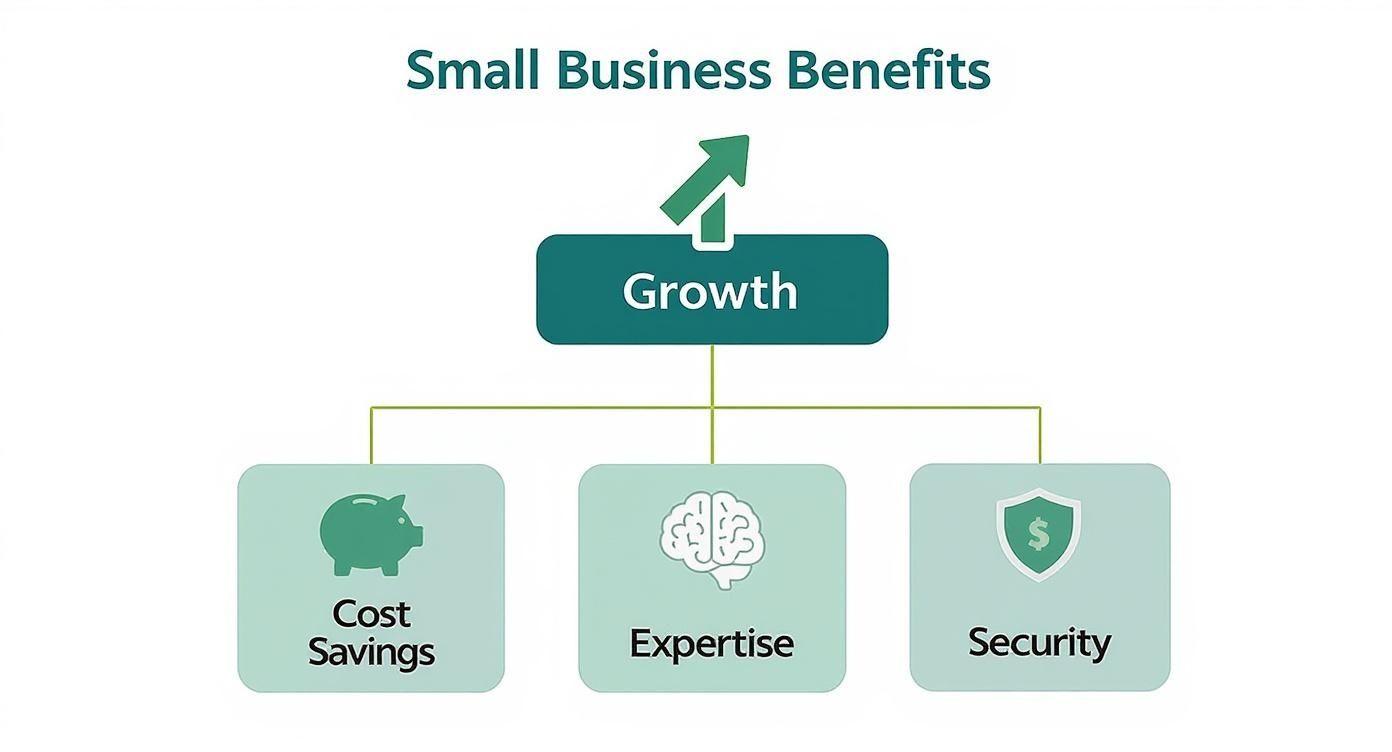
As you can see, once your fundamental IT needs are managed by experts, your business is in a much stronger position to expand and compete, whether you're in San Diego or San Francisco.
Proactive System Monitoring and Maintenance
This is the absolute cornerstone of any managed services agreement. Your provider isn’t just sitting by the phone waiting for your call; they are actively watching over your digital infrastructure 24/7 to stop problems before they can cause costly downtime.
Using sophisticated tools, they keep a constant eye on the health and performance of your entire network—servers, workstations, and all the critical devices in between. By spotting potential issues early, an MSP can often resolve them quietly in the background before you or your team in Santa Ana even realize anything was amiss.
This preventative care includes all those crucial but easy-to-forget tasks like applying software patches and system updates that are vital for keeping your systems stable and secure.
Comprehensive Cybersecurity Defence
In this day and age, solid security isn't just a nice-to-have, it's a necessity. Cybercriminals love to target small businesses, betting on the assumption that their defences are weaker. A managed service plan counters this with a multi-layered security strategy designed to protect your sensitive data and, by extension, your reputation.
For many small businesses, understanding the depth of Managed IT Services Security is the first step toward true protection. It's so much more than just installing antivirus software. A proper defence system typically includes:
- Advanced Firewalls: The digital gatekeeper for your network, controlling what comes in and what goes out.
- Threat Detection: A vigilant system that continuously scans for malware, ransomware, and other suspicious activity.
- Security Audits: Regular check-ups to find and fix vulnerabilities in your systems.
- Employee Training: Giving your team the knowledge to spot and avoid phishing scams and other clever social engineering tactics.
This vigilant approach gives California business owners invaluable peace of mind, knowing their digital assets are properly protected.
Unlimited Help Desk and User Support
When someone on your team hits a technical wall, they need help, and they need it fast. A key part of any managed service plan is responsive, friendly help desk support for all your employees.
This means your staff has a direct line to a team of IT pros who can quickly troubleshoot anything from software glitches and password resets to printer problems. Most plans offer unlimited support for a flat monthly fee, so you never have to hesitate or worry about racking up extra costs just because your team needs help.
This on-demand expertise ensures that minor IT hiccups don't snowball into major productivity killers, keeping your whole team focused on their actual jobs.
Backup and Disaster Recovery Planning
Take a moment and ask yourself: what would happen if a fire, flood, or a major cyberattack wiped out your systems tomorrow? A well-thought-out backup and disaster recovery (BDR) strategy is what ensures your business can survive that kind of crisis and get back on its feet quickly.
Your provider will set up automated, regular backups of all your critical data, storing them securely both locally and in the cloud for redundancy. More importantly, they'll work with you to create a clear recovery plan to restore your operations with minimal disruption. This is the difference between a temporary headache and a catastrophic business failure for a business anywhere in California. You can learn more about building a resilient strategy in our guide to effective data backup solutions.
Strategic IT Consulting
Finally, a true IT partner does more than just fix what's broken. They help you plan for what's next. This is where strategic IT consulting, often called a virtual Chief Information Officer (vCIO) service, comes into play. It’s all about aligning your technology with your bigger business goals.
Your vCIO helps you build a technology roadmap, budget for future investments, and make smart decisions about new software or hardware. For any growing California enterprise, this guidance is what turns technology from a simple operational cost into a real competitive advantage.
Finding the Right IT Partner in California
Choosing a managed service provider isn't like picking out a new piece of software. It’s much more like bringing on a long-term business partner. This decision isn't just about technical specs or who has the lowest price—it's about finding a team whose expertise, responsiveness, and even company culture clicks with your own business goals.
When you get it right, the partnership feels like a natural extension of your own team, genuinely invested in your success. But get it wrong, and you're in for a world of frustration, surprise costs, and nagging operational problems. The trick is to go into the search with a clear head and the right questions at the ready.
Can They Get to You When It Counts?
When your entire network crashes mid-afternoon, you need help now, not tomorrow. This is where a provider's physical location can make all the difference, especially for hardware failures or tricky problems that need a hands-on fix.
You need to ask some direct questions about what they can actually do in your specific area. A provider headquartered up in Sacramento probably isn't the best choice if your office is down in Orange County.
- On-Site Support: What's their guaranteed response time for getting a technician to your office?
- Local Teams: Do they have actual engineers based in your region, whether it's the Bay Area, Central Valley, or Southern California?
- Remote Fixes: What percentage of problems do they solve remotely, and how fast do they typically get it done?
A provider with a solid local presence not only understands the regional business climate but can also deliver much faster, more effective support when you truly need someone on-site.
Do They Speak Your Industry's Language?
Let's be honest, not all IT needs are the same. A healthcare clinic in Fresno has a completely different set of security and compliance rules to worry about than a construction company in Long Beach does. Your ideal partner needs to have real, hands-on experience with the specific technical and regulatory hurdles of your field.
For example, if you're handling sensitive patient data, your provider better be a HIPAA compliance guru. If you're a financial services firm, they need to know FINRA and SEC regulations inside and out.
Before you even think about signing a contract, ask for case studies or, even better, references from businesses in your industry. It's the only way to be sure they have the practical experience to keep your operations safe and compliant.
Get to Know the Service Level Agreement (SLA)
The Service Level Agreement, or SLA, is the single most important document in your contract. It's a legally binding agreement that spells out exactly what services you'll get and the performance standards the provider is promising to meet. Don't just skim it—read every single word.
You're looking for clear, measurable promises, not vague assurances. Pay close attention to these key metrics:
- Guaranteed Uptime: What percentage of time do they guarantee your systems will be up and running (e.g., 99.9%)?
- Response Times: How quickly will they acknowledge a support ticket and start working on it, based on its severity?
- Resolution Times: What is their target for completely fixing different types of issues?
A rock-solid SLA creates accountability and gives you a leg to stand on if the service doesn't live up to what was promised.
Are They a Partner or Just a Vendor?
At the end of the day, the best managed it services for small business come from a provider who acts like a true partner. This means they actually take the time to learn about your business goals and proactively suggest ways technology can help you get there. They should care more about your long-term success than just making a sale.
California's small businesses are leaning more and more on managed IT services to handle their complex tech needs. While regional players like K3 Technology in San Diego and TPX Communications in Los Angeles offer specialized services, localized MSPs like MotivIT give SMBs scalable, personal support that boosts their resilience without the massive cost of an enterprise-level IT department. You can find more insights about the top MSPs in California on motivit.com.
As you talk with potential providers, pay attention to their approach. Are they listening more than they're talking? Are they asking smart questions about how your business works? A partner invests in your growth; a vendor is just there to sell you something. For more guidance, check out our resources covering IT support in California.
Understanding the Cost of Managed IT Services

Let's talk about the price tag on managed IT services for small business. It can feel like a complex topic, but it really boils down to a shift in mindset. Instead of seeing it as another line item on your monthly expenses, think of it as a strategic investment in your company's stability and growth.
The old way of handling IT often involved unpredictable, and frankly, shocking bills for emergency repairs. Managed services flip that script entirely, giving you a predictable expense you can actually budget for. This predictability is a game-changer for any California business. You move from reactively throwing money at a crisis to proactively funding a system designed to stop those crises from ever happening.
Common Pricing Models Explained
Most IT providers structure their pricing in a few common ways. Getting familiar with these models is the first step to finding a plan that fits your business like a glove.
- Per-User Model: Simple and straightforward. You pay a flat monthly fee for each employee using the IT services. This is a popular pick for businesses where every team member is juggling multiple devices, as it makes budgeting a breeze.
- Per-Device Model: Here, the cost is tied to the number of devices—desktops, servers, laptops—under management. It's a great fit for businesses with shared workstations or environments where not every employee needs constant, direct support.
- Tiered Plans: Think of these as bundled packages, often labelled something like bronze, silver, and gold. Each tier offers a progressively deeper set of services, letting you pick a pre-packaged plan that aligns with your budget and technical needs.
No matter the model, the final cost will naturally be influenced by factors like the size of your team, the complexity of your network, and any specific compliance regulations your industry has to follow.
The True Cost of Not Having Managed IT
To really understand the value, you have to weigh the monthly fee against the alternative. A predictable investment might seem like a notable expense until you stack it up against the crippling—and completely unpredictable—cost of a major IT disaster.
What’s the financial fallout when a server crash brings your entire team to a grinding halt for a day? A single data breach can trigger massive fines, lawsuits, and an erosion of customer trust that could take years to rebuild, if you can rebuild it at all.
When you look at it that way, the monthly investment in proactive IT management is really a form of insurance against operational and financial catastrophe.
Recent market analysis shows many small businesses spend between 3% and 6% of their annual revenue on IT. This figure often climbs to between 6% and 10% in highly regulated industries like healthcare and finance, where that budget covers everything from hardware to essential cybersecurity. You can find more insights on local IT spending trends here.
Ultimately, putting money into managed IT is an investment in your business’s ability to stay resilient and competitive. It creates stability, guards against modern threats, and frees you up to focus on what you do best. A big part of that protection is solid cybersecurity, which you can read more about in our guide to the best antivirus software for small business.
It’s Time to Take Control of Your Business Technology
Let's face it, ignoring your IT infrastructure and just hoping for the best isn't a strategy for success anymore. Throughout this guide, we've explored how managed IT services can give small businesses in California the security, efficiency, and expert guidance they need to not just compete, but to thrive. Think of proactive IT management less as a defensive shield and more as a competitive sword.
This isn't just about preventing costly downtime anymore; it's about actively defending your business against a constant barrage of cyber threats. With so many of us working remotely and selling online, a solid, reliable technology foundation has gone from being a "nice-to-have" to an absolute necessity for businesses in Oakland, San Jose, and beyond.
The New Digital Reality
The shift to a digital-first world has accelerated massively, especially for businesses figuring out how to operate in a post-pandemic market. This rapid change means that your IT system is now the very backbone of your customer service and sales operations.
Take Los Angeles, for example. In a single quarter of 2021, online e-commerce transactions exploded to $222.5 billion—a 3.3% jump from the previous quarter. This surge forced countless local shops and service providers to lean heavily on their IT systems, often managed by expert MSPs. You can get a closer look at the Los Angeles IT landscape on itsasap.com.
That statistic paints a clear picture: your ability to serve customers and bring in revenue is now directly tied to how well your technology works.
A proactive IT strategy does more than just fix problems when they break. It builds a more resilient and successful future for your business by turning technology into a reliable asset for growth.
Your Next Step Is Simple
You don’t need to have all the answers right now. The single most important thing you can do is to just start the conversation.
Begin by taking an honest look at your technology as it stands today. What's working well? What's causing constant headaches for your California team? Where do you feel the most exposed?
From there, you can begin to see how a strategic IT partnership could fill those gaps. It’s all about creating a plan that lines up your technology with your actual business goals, making sure every tool and system you use is helping you move forward, not holding you back.
Your Questions, Answered
Deciding on an IT partner is a big move, and it’s natural to have questions. Whether you're a startup in the Bay Area or a growing business in San Diego, getting straight answers is key. Let's tackle some of the most common questions we hear from California business owners.
We've put together some no-fluff answers to help you figure out if a managed IT partnership is the right call for your company.
Is My Business Too Small for Managed IT?
Not at all. In fact, this is one of the biggest myths out there. Smaller businesses often gain the most from working with a managed service provider. Good providers build plans that scale, whether you're a one-person shop in Sacramento or a team of 20 in Los Angeles.
Think of it this way: even a solo entrepreneur gets access to enterprise-level cybersecurity and expert support that used to be reserved for huge corporations. It levels the playing field, ensuring your technology is as solid and secure as your biggest competitors'.
What’s the Difference Between Managed Services and Break-Fix Support?
Understanding this is critical because they are two completely different ways of thinking about your technology.
-
Break-Fix Support: This is the classic reactive approach. You wait for something to break—a server goes down, a laptop gets a virus—and then you call for help. The problem with this model is that it guarantees downtime, lost productivity, and often a hefty, unexpected bill for emergency service.
-
Managed Services: This is a proactive strategy. Your provider keeps an eye on your systems 24/7, catching potential issues before they can cause a headache. Their success is tied directly to your stability, making it a genuine partnership built on keeping you up and running.
The real difference is in the motivation. A break-fix company profits when you have problems. A managed services provider profits when you don't. You're shifting from paying for disasters to investing in uptime.
How Long Does It Take to Switch to a Managed IT Provider?
It’s a much smoother and quicker process than you might imagine. A good provider will have a well-oiled onboarding process designed to cause as little disruption as possible. While every business is different, a typical switch usually takes just a few weeks from the initial handshake to full handover.
The process is handled systematically to make sure no detail is overlooked. It usually looks something like this:
- A deep dive into your current IT setup at your California office.
- Careful documentation of your entire network, from hardware to software.
- Deploying the tools needed for remote monitoring and management.
- A seamless transition of all IT support tasks to the new team.
A skilled provider pilots this entire journey for you, making the change feel almost invisible so you can keep your focus where it belongs: on your business.
Ready to stop worrying about technology and start focusing on growth? Klimka Computer Solutions provides reliable, proactive managed IT services designed for small businesses. Contact us today for a free consultation and see how we can build a more secure and efficient future for your company.
No Responses